How to Remove Calcium Buildup on Pool Tile
That white crust at the waterline is calcium, not dirt, and scrubbing harder makes it worse. Here is what actually removes it without wrecking the tile.
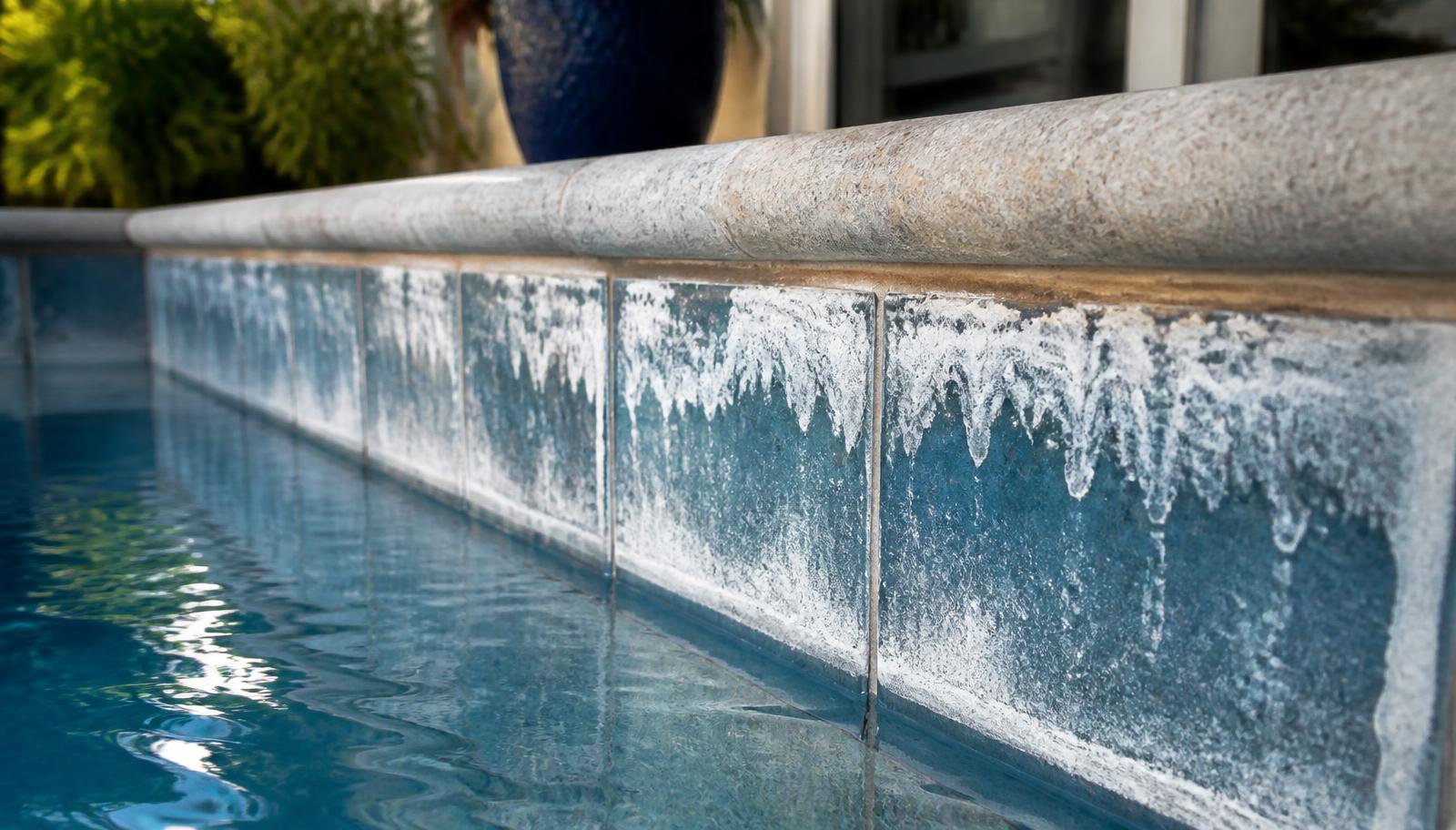
Calcium buildup on pool tile is removed by dissolving or abrasively blasting the scale, not by scrubbing — a stiff brush and a household cleaner will polish it and leave it there. Central Florida fill water carries a lot of dissolved minerals, and constant evaporation on the Space Coast concentrates them right at the waterline, which is why nearly every pool in Brevard County eventually grows a white band.
What causes calcium buildup in pools?
Scale forms when calcium in the water comes out of solution and deposits on a surface. Three conditions drive it: hard fill water, high pH and total alkalinity, and evaporation that concentrates the remaining minerals. All three are routine here, and summer evaporation makes the waterline the first place it shows.
| Type | What it looks like | Removal approach |
|---|---|---|
| Calcium carbonate | White, flaky, crumbles under a coin | Dissolves with acidic cleaner; responds to bead blasting |
| Calcium silicate | Grey-white, hard, does not flake | Needs professional blasting |
| Calcium nodules | Small white bumps on plaster | Surface issue; assess before treating |
| Salt crust | Powdery white above the waterline | Wipes off; common on salt pools |
The fizz test tells you which one you have. A drop of muriatic-based cleaner on the deposit will bubble on calcium carbonate and do almost nothing on silicate.
Can you remove calcium buildup yourself?
A light carbonate haze, yes. A pumice stone works on plaster and unglazed tile, and a purpose-made calcium remover works on a thin film if you follow the label. Two rules matter more than technique: never use a pumice stone on glass, glazed or stone tile, and never use household acids on a filled pool without knowing what they do to your chemistry.
- Pumice stone: plaster and unglazed tile only, kept wet the whole time
- Commercial scale remover: light film, applied to a small test area first
- Vinegar or diluted acid: minor deposits, limited results, harsh on grout
- Never a wire brush, never a household abrasive pad, never on glass tile
How do professionals remove heavy scale?
Heavy or silicate scale comes off with media blasting — glass bead, salt or soda propelled at the tile under pressure, which chips the deposit away without cutting the tile surface. The medium is matched to the tile: soda for delicate glass and softer surfaces, glass bead for tougher scale on porcelain and stone. That is what pool tile cleaning covers, and it is the only method that clears a heavy band without damage.
Blasting is usually done with the water lowered a few inches so the whole band is exposed. On a badly scaled and stained pool, it is often paired with an acid wash or drain and clean.
The tile is not stained. It is buried. Everything that works removes material rather than cleaning it.
How do you stop calcium from coming back?
- 01Keep pH between 7.4 and 7.6 and total alkalinity in range, since high pH drives scale formation.
- 02Test calcium hardness and keep it within the normal range for your surface type.
- 03Brush the waterline weekly so a film never becomes a crust.
- 04Top the pool up steadily instead of letting the level drop and refilling with a large volume of hard water.
- 05Watch for scale on the salt cell too — a scaled cell stops producing chlorine.
Weekly chemical balancing is what keeps this from repeating. Scale is a chemistry outcome, and once the water is stable the tile stays clean for years rather than months.
How often should pool tile be cleaned in Florida?
Most residential pools here need a professional tile cleaning every two to four years, with weekly brushing in between. Pools with hard fill water, high evaporation, or a history of high pH land at the shorter end. If yours is already showing a white band you can feel with a fingernail, contact us with a photo of the waterline and we can tell you whether it is carbonate or silicate before booking anything.
How to Remove Calcium Buildup on Pool Tile FAQs
What causes calcium buildup on pool tile?
+
Hard water, high pH and alkalinity, and evaporation that concentrates minerals at the waterline. Florida fill water and year-round heat make it common.
Can I use vinegar to remove pool calcium?
+
Vinegar can soften very light deposits but rarely removes an established crust, and it is hard on grout. Heavy scale needs blasting.
Will a pumice stone scratch pool tile?
+
Yes, on glass, glazed ceramic and polished stone. Use it only on plaster or unglazed tile, and keep both the stone and the surface wet.
How often does pool tile need professional cleaning?
+
Every two to four years for most Florida residential pools, sooner if the water frequently runs at high pH or the fill water is very hard.