Sand Filter vs Cartridge Filter: Which Is Better for a Florida Pool?
A cartridge filter traps finer particles and wastes no water on backwashing, so it suits most year-round Florida pools. A sand filter is simpler to look after but lets more fine debris through.
Sand filter vs cartridge filter comes down to how fine you want the water filtered and how you want to look after it. A cartridge filter catches particles down to about 10 to 20 microns and is cleaned by lifting out and rinsing the element, with no backwashing. A sand filter catches particles in the 20 to 40 micron range and is cleaned by backwashing water out to waste. For most year-round Florida pools, a correctly sized cartridge filter is the better fit.
Quick answer: Choose a cartridge filter if you want clearer water and no water lost to backwashing. Choose sand if you want the simplest routine and can accept slightly coarser filtration. DE filters finest of all but takes the most handling. Pearlin Pools' view for Brevard County pools is that cartridge filters trap finer particles and waste no water backwashing, which matters on the barrier island, while sand is cheaper to maintain but lets more fine debris through.
How do sand and cartridge filters work?
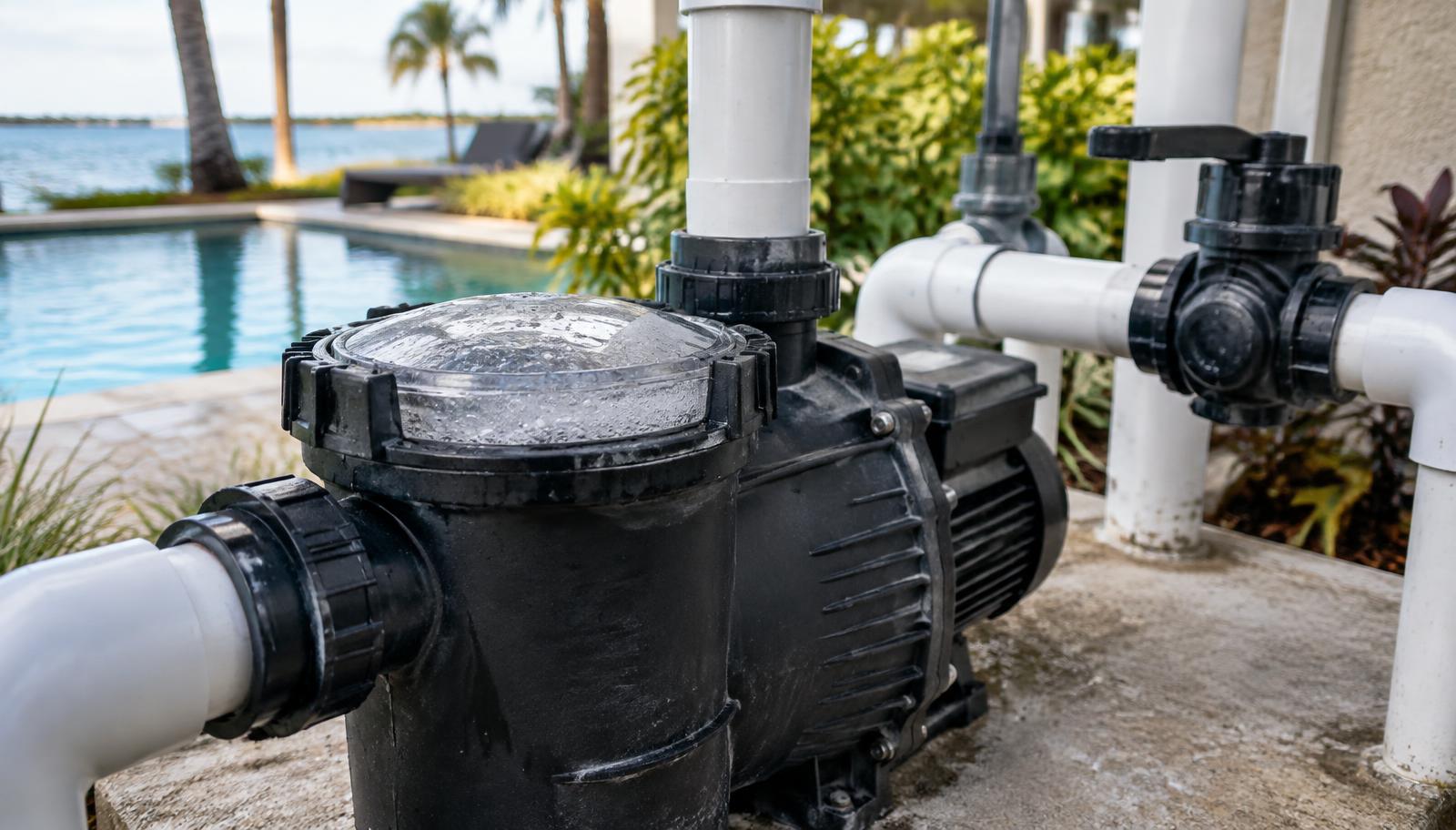
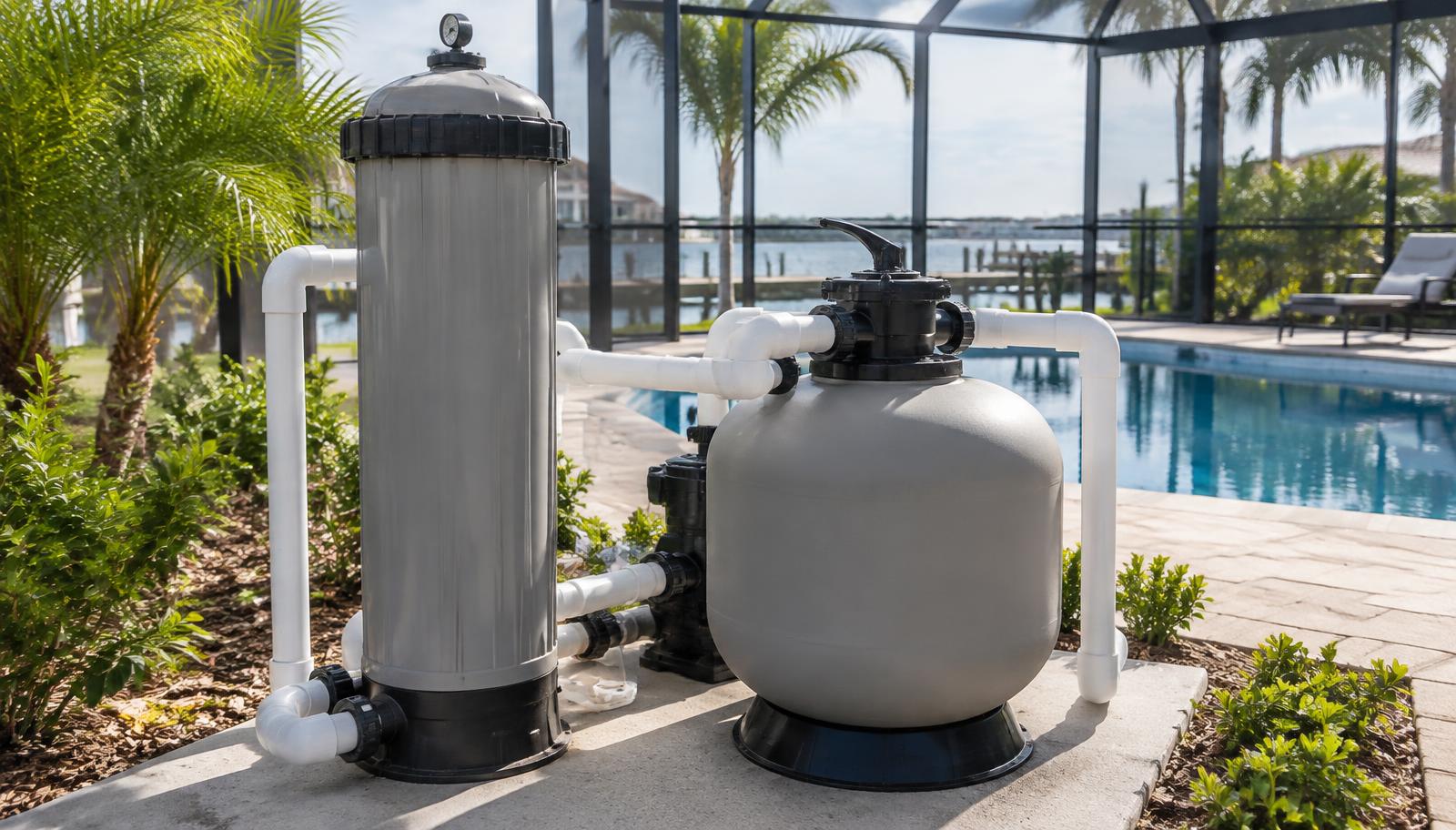
A pool filter is the tank on your equipment pad that strains dirt out of the water after the pump pushes it through. A sand filter sends the water down through a bed of specially graded filter sand, and dirt lodges between the grains. A cartridge filter pushes the water through a pleated fabric element, and dirt collects on the surface of the pleats. Both are cleaned when the pressure gauge reads 8 to 10 psi above its clean starting value.
Filter ratings are given in microns. A micron is one thousandth of a millimeter, and Hayward's guide to the differences between filter types puts a human hair at about 40 to 50 microns wide. So even a sand filter catches particles finer than a hair. The difference shows up with the very fine material: pollen, dust and the haze left after an algae treatment.
A DE filter is the third type. DE is short for diatomaceous earth, a fine white powder made from fossilized diatoms. It coats a set of fabric grids inside the tank, and that powder layer does the filtering.
Sand filter vs cartridge filter compared side by side
The table below uses Hayward's published micron ranges and the service schedule Pearlin Pools works to on Space Coast pools.
| Factor | Sand | Cartridge | DE |
|---|---|---|---|
| Particles captured | About 20 to 40 microns | About 10 to 20 microns | About 3 to 5 microns |
| How it is cleaned | Backwash to waste when pressure climbs | Lift out the element and rinse it, with a periodic overnight soak | Backwash, then add a fresh charge of DE powder |
| Water used to clean | Backwash water goes to waste | Only hose rinse water | Backwash water goes to waste |
| Routine service | Backwash as needed, replace sand media every 4 to 6 years | Deep clean every 4 to 6 months, replace the element every 2 to 3 years | Deep clean the grids twice a year |
| Hands-on effort | Lowest | Moderate | Highest |
Which filter is better for a Florida pool?
For most Brevard County pools, Pearlin Pools favors a generously sized cartridge filter. Pools here run twelve months a year, so the filter never gets a winter break, and the fine debris that clouds Florida water, spring pollen and wind-blown sand among it, is exactly the material a sand bed lets slip through.
A cartridge filter also skips backwashing. Every backwash on a sand or DE filter sends water you have already balanced out to waste, and the refill water has to be balanced again. Hayward makes the same point in the guide above: because a cartridge filter does not backwash, water balance tends to stay where you set it, and it saves the water the other types use for backwashing.
Sand still makes sense in some cases. If you have a sand filter in good condition, there is no reason to rip it out. If you would rather turn a valve than lift out and rinse a cartridge, sand is the easier routine. And many existing sand tanks can take filter glass in place of sand, which Pearlin Pools replaces as part of filter service.
Is a cartridge filter more work than a sand filter?
A little more work per cleaning, but cleanings are spread out. A sand filter needs a backwash each time the gauge climbs 8 to 10 psi above the clean reading, which takes a few minutes at the valve. A cartridge needs the element lifted out and rinsed at the same pressure rise, plus an overnight soak in filter cleaner every four to six months on Pearlin Pools' schedule, because hosing alone leaves body oils, sunscreen and mineral scale behind.
Our guide to how often to clean a pool filter covers the pressure rule and the schedule for each filter type in more detail, including when replacing the media beats another cleaning.
What about DE filters?
DE gives the finest filtration of the three. Hayward rates it at about 3 to 5 microns, so it produces the most polished water, which you notice most under pool lights at night. The trade off is handling: every backwash sends DE powder out with the waste water, a fresh charge has to be added through the skimmer, and Pearlin Pools deep cleans DE grids twice a year.
Backwash water from sand and DE filters carries more than water. Florida stormwater guidance, such as Orange County's pool pollution prevention page, lists DE powder and sand among the materials found in pool discharge and says never to send it into a street, storm drain or any surface water. On waterfront lots along the lagoon and the rivers, that is worth weighing before you choose a filter that backwashes.
Can you switch from a sand filter to a cartridge filter?
Yes. Switching means replacing the filter tank and replumbing the connections on the equipment pad, because the two types use different housings. Most cartridge filters do not use the multiport valve, the handle on a sand filter with settings such as filter, backwash and waste. A swap is also the right moment to size the new filter for your pump. Hayward suggests going oversized, because a larger filter gives you a longer stretch between cleanings.
Pearlin Pools handles filter swaps as part of equipment installation, which starts with an audit of the pad: flow rate, plumbing size and electrical capacity are checked before anything is replaced, and unions and valves are laid out so future repairs are simple. For what drives the cost of a filter swap, see the pool service cost guide.
Signs your current filter is not keeping up
- The water stays hazy even though the chemistry and pump run time are right. Our guide to cloudy pool water causes and fixes walks through how to confirm the filter is the problem.
- The pressure climbs back up within days of a proper cleaning or backwash.
- Sand shows up on the pool floor near the returns. Sand is getting past the bed, and a teardown is how to find out why: cracked laterals, the slotted arms at the bottom of a sand tank, are one of the faults Pearlin Pools checks for.
- DE powder blows back into the pool after a recharge, a sign of a torn grid.
- Cartridge pleats are soft, flattened, torn or separating from the end caps.
Most of these are a filter service, not a reason to change filter type. Pearlin Pools' pool filter cleaning covers a full teardown, an overnight chemical soak for cartridges, DE grid cleaning, sand or glass media replacement, new o-rings and a verified pressure reading after reassembly.
Next steps
If your filter is due for service, start with a cleaning and a fresh clean-start pressure reading. If it is worn out or undersized and you are weighing sand against cartridge, book a visit online or send us a message with your filter type, pool size and current gauge reading, and we will confirm by text or call.
Sand Filter vs Cartridge Filter FAQs
Which pool filter gives the clearest water?
+
DE filters capture the finest particles, about 3 to 5 microns according to Hayward, followed by cartridge filters at about 10 to 20 microns and sand at about 20 to 40 microns. In practice a well-maintained cartridge filter keeps most Florida pools clear, and DE is the choice when you want the most polished water.
How long does a cartridge filter element last in Florida?
+
Pearlin Pools replaces cartridge elements every two to three years in Brevard County, sooner on pools that fight heavy pollen or lagoon-side algae. Deep cleaning the element every four to six months, rather than only hosing it, helps it reach the full lifespan.
How often does the sand in a pool filter need replacing?
+
Pearlin Pools replaces sand media every four to six years. Replace it sooner if the sand has hardened into clumps or channels, because water then bypasses the bed and the filter stops catching fine debris even when the pressure gauge looks normal.
Can I put filter glass in a sand filter instead of sand?
+
Many sand filters can take filter glass in place of sand, and Pearlin Pools replaces both sand and glass media as part of filter service. Check the manual for your filter model first, since the manufacturer lists the media and amount the tank is designed for.