Pool Chemical Levels: The Florida Owner's Guide
Six numbers run a pool. Here are the ranges that hold up in Space Coast heat, the order to correct them in, and what happens when each drifts.
Pool chemical levels come down to six readings: free chlorine, pH, total alkalinity, cyanuric acid, calcium hardness and salt if you run a generator. Get those into range and everything else — clarity, comfort, surface life, equipment life — follows. Florida makes the job harder than most states, because the sun burns chlorine off fast and Satellite Beach summer storms dilute the water without warning.
What are the target levels for a Florida pool?
| Reading | Target range | Why it matters here |
|---|---|---|
| Free chlorine | 2 to 4 ppm | Sun and heat consume it faster than in northern pools |
| pH | 7.4 to 7.6 | Above 7.8 chlorine weakens and scale forms |
| Total alkalinity | 80 to 120 ppm | Buffers pH against rain and acid dosing |
| Cyanuric acid | 30 to 50 ppm (higher on salt pools) | Shields chlorine from UV; too much stalls it |
| Calcium hardness | 200 to 400 ppm | Too low etches plaster, too high scales tile |
| Salt (salt pools) | Per the generator's spec | Low salt stops chlorine production |
Which order do you correct them in?
Always the same order, because each reading affects the next. Total alkalinity first, since it stabilizes pH. Then pH. Then chlorine, then stabilizer, then calcium. Correcting chlorine while pH sits at 8.0 wastes product, because the chlorine that is there is barely working.
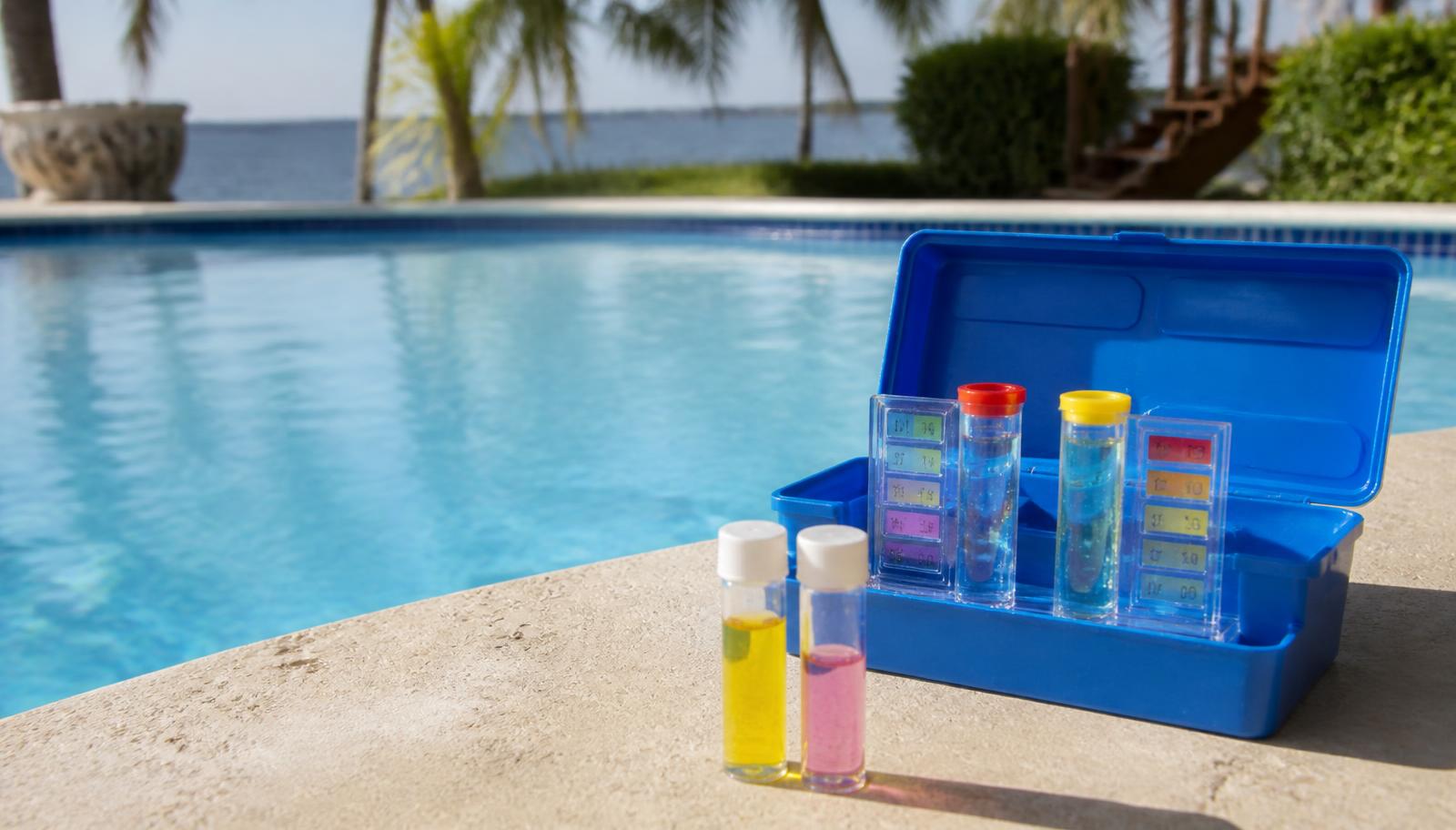
- 01Test with a fresh reagent kit or test strips that have not been sitting in a hot garage.
- 02Adjust total alkalinity into the 80 to 120 ppm band.
- 03Adjust pH to 7.4 to 7.6.
- 04Bring free chlorine to 2 to 4 ppm.
- 05Check cyanuric acid; the only cure for too much is dilution.
- 06Adjust calcium hardness last, and only when it is well outside range.
Why does chlorine disappear so fast in Florida?
Ultraviolet light destroys unstabilized chlorine within hours, and Brevard County gets intense sun year-round. That is what cyanuric acid is for: it shields chlorine from UV. Without it, a pool can lose most of its free chlorine in a single sunny afternoon, which is why unstabilized pools bloom so quickly here.
Heat compounds it. Warmer water speeds up every reaction in the pool, including the ones that consume sanitizer, and bather load in summer adds more organic demand.
What does high pH do to a pool?
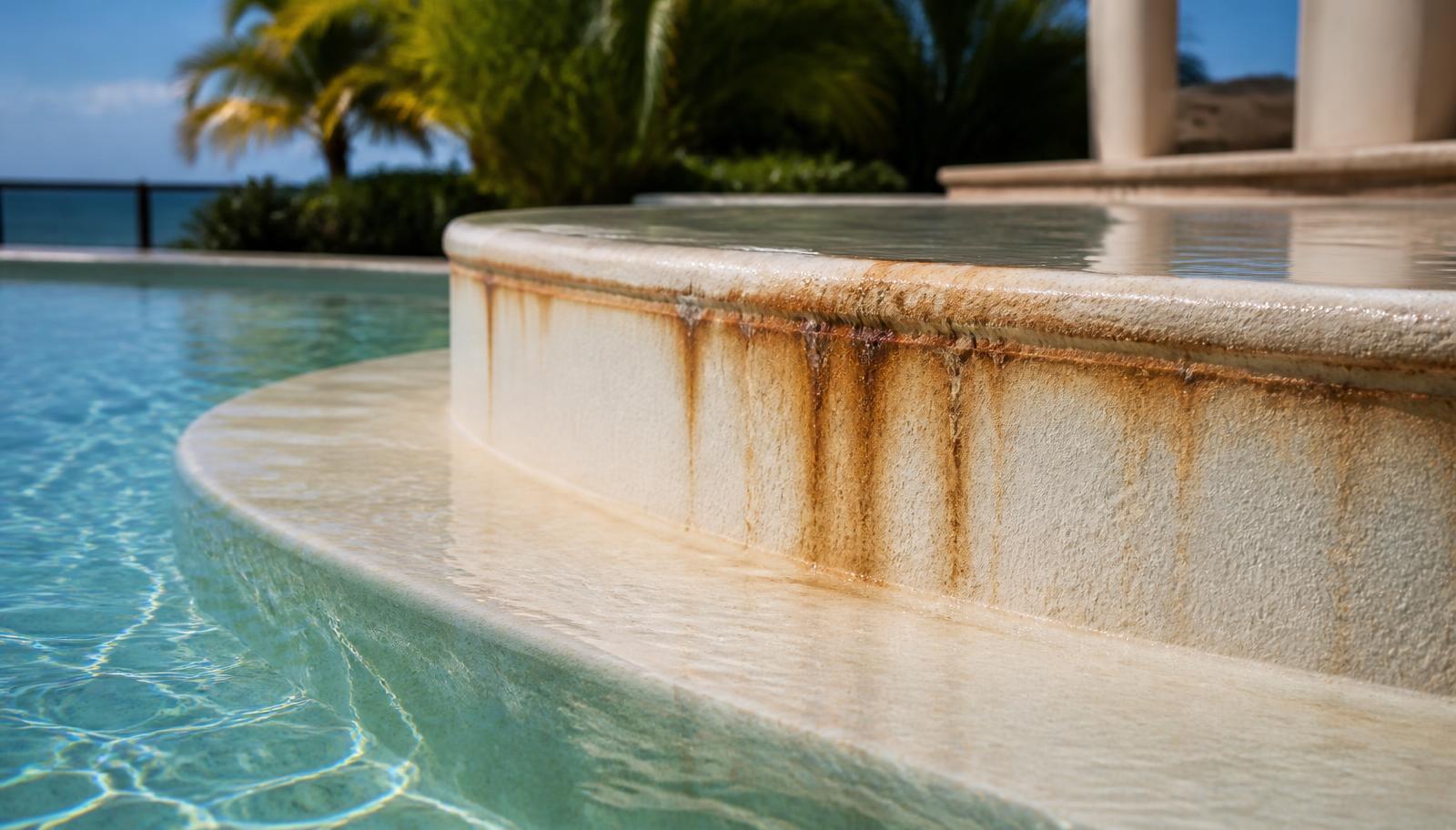
High pH weakens chlorine, clouds the water, and pushes calcium out of solution onto the tile and the salt cell. It is also the most common out-of-range reading on the coast, because salt chlorine generators drive pH upward as they produce chlorine, and because plaster surfaces raise pH as they cure.
Low pH is less common but harder on equipment: it corrodes metal fittings, etches plaster and irritates swimmers.
Chlorine gets the blame for everything. Nine times out of ten it is pH deciding whether that chlorine works.
How often should you test pool water?
- Weekly at minimum, all year — Florida pools have no off-season
- Twice a week in June through September, and after any heavy rain
- After a storm, a party, or any large bather load
- Before and after adding any chemical, so you learn how your pool responds
- Quarterly for cyanuric acid and calcium hardness, which move slowly
What rain does to your numbers
A Space Coast afternoon storm can drop total alkalinity, dilute chlorine and stabilizer, and shift pH in one sitting. That is normal, and the correction is straightforward: circulate for a day, then test and rebalance in the order above. The details are in what to do after heavy rain.
Do you need a professional for chemistry?
Plenty of owners handle it themselves. The ones who hand it off are usually tired of chasing the same problem — the pool clouds every August, or algae keeps returning, or the salt cell keeps scaling. Weekly pool chemical balancing with a consistent log is what breaks that cycle, and weekly pool cleaning includes it. If your numbers are already far out and the water is turning, contact us before you dump more chemicals into it.
Pool Chemical Levels FAQs
What should chlorine level be in a Florida pool?
+
Free chlorine of 2 to 4 ppm, supported by cyanuric acid in the 30 to 50 ppm range so the sun does not burn it off within hours.
What is the ideal pH for a swimming pool?
+
7.4 to 7.6. Above 7.8 chlorine loses effectiveness and scale forms; below 7.2 the water becomes corrosive to plaster and metal.
In what order should I adjust pool chemicals?
+
Total alkalinity, then pH, then chlorine, then stabilizer, then calcium hardness. Correcting out of order wastes product.
How often should I test my pool water in Florida?
+
Weekly year-round, and twice weekly in summer or after heavy rain, since heat and storms move the numbers quickly.